
SEO
SEO
Link building: what it is and how to earn backlinks without risk
Link building is the work of getting other websites to link to yours. Links remain one of the signals Google uses to discover pages and judge their relevance, but only links earned on editorial merit count: buying links or trading them at scale violates Google's spam policies. The safe path is creating real reasons to be cited, such as original data, useful assets and relationships with partners and the press.
Key takeaways
- A link is worth its relevance and editorial context, not its domain authority score.
- Paid links need
rel="sponsored"; without it they violate Google's policies. - Since 2022, SpamBrain makes artificial links stop counting: many bought links are simply worthless.
- Internal links are the first lever, and the only one fully under your control.
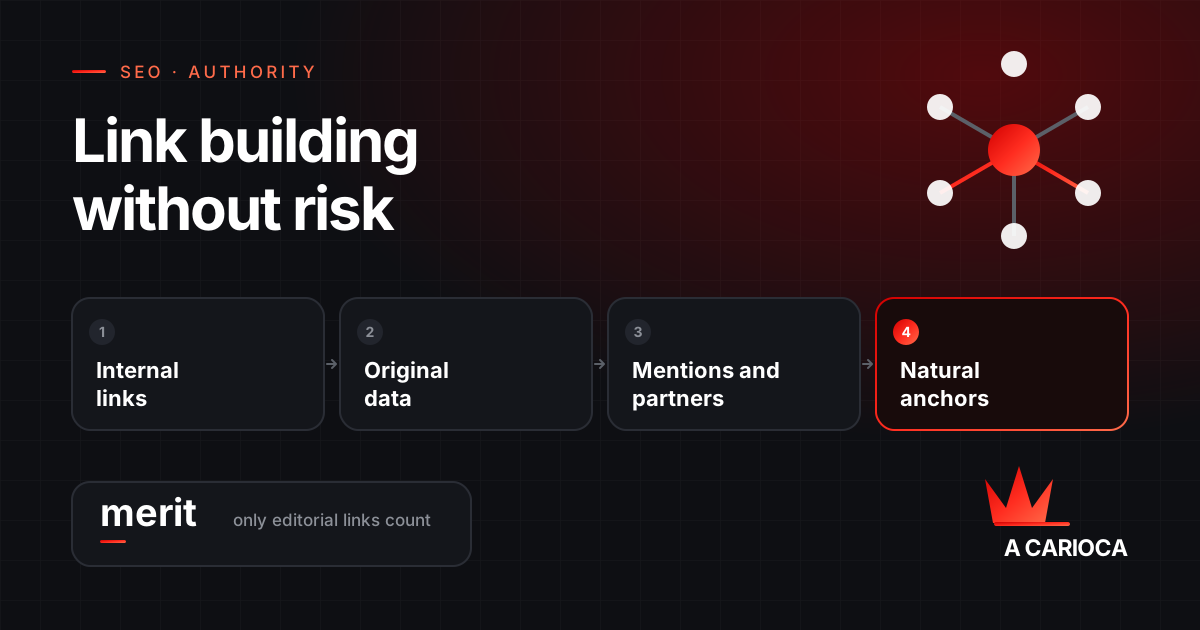
- The tactics that last: original data, unlinked mentions, broken links, partners and the press.
What link building is and why links still matter
To Google, a link from another site works like a recommendation: someone found that page useful enough to cite it. That was the original idea behind PageRank, and it is still part of how Google discovers and evaluates pages, even though today it is one signal among many.
That is why the reason behind a link matters more than the count. An editorial link in an article from your industry conveys relevance; a hundred links from directories nobody visits convey almost nothing, and sometimes they convey risk.
Link building, then, is less about getting links and more about creating reasons to be cited, and then making sure the people who could cite you know you exist.
What Google considers manipulation
Google's spam policies define a link scheme as any attempt to manipulate rankings through links. The most common cases:
- Buying or selling links that pass ranking credit, whether for money, products or services.
- Excessive link exchanges made purely for linking's sake.
- Large-scale guest posting campaigns with keyword-rich anchor text.
- Automated programs that create links to your site.
- Requiring a link as part of a contract or terms of service without letting the site owner qualify it.
The attributes that make a link legitimate
Since 2019 Google has recognized three attributes to describe the nature of a link. They do not forbid the link; they signal that it should not pass ranking credit.
| Attribute | When to use it |
|---|---|
rel="sponsored" | Paid links, advertising, sponsorships and affiliate links. |
rel="ugc" | User-generated content such as comments and forum posts. |
rel="nofollow" | Any other case where you do not want to endorse the destination. |
Paid advertising is legitimate. The problem is a paid link dressed up as editorial, without the attribute, because it tries to buy what should be earned.
Why buying links stopped paying off
With the December 2022 link spam update, Google began using SpamBrain, its AI-based spam detection system, to identify both the sites that buy links and the sites that exist to sell them. Links detected as artificial simply stop counting.
That changes the math for buyers. The old risk was a manual penalty that might never arrive. Today the likelier outcome is paying for links the algorithm already ignores: the money is gone and rankings do not move. In the worst case, a blatant pattern can still trigger a manual action for unnatural links, visible in Search Console.
This is why we do not price link building per link. A per-link price list creates exactly the incentive to buy volume, which is precisely what Google neutralizes.
How to evaluate whether a backlink is worth it
Domain authority scores from Ahrefs, Moz or Semrush are those companies' estimates, not Google's. They are fine for a first pass and poor at deciding on their own. Judge each opportunity against these criteria:
| Criterion | Question to ask | Red flag |
|---|---|---|
| Relevance | Does the site cover your industry or audience? | A generic site that publishes about anything |
| Editorial context | Is the link in the body of a text that makes sense? | A loose link in a footer, sidebar or partner list |
| Real traffic | Does the site get genuine organic visits? | High authority score with near-zero traffic |
| Indexing | Is the page that will host the link indexed? | A new page on a site Google barely crawls |
| Outbound links | Does the site link to many unrelated sites? | Dozens of links to gambling, crypto and payday loans |
| Anchor text | Does the link text read naturally? | The same exact-match commercial anchor across many sites |
The simplest test of all: if Google did not exist, would you still want this link for the visitors it sends? If the answer is no, Google probably will not value it either.
Start with internal links
Before chasing links elsewhere, use the ones you control. Internal links distribute authority across your own pages and tell Google which ones matter most.
- Pages that already earn external links should link to the pages you want to strengthen.
- Every important page should sit a few clicks from the homepage and receive links from related pages.
- Use descriptive anchors: "SEO audit" tells Google far more than "click here".
- Orphan pages with no internal links rarely rank, however good they are.
Link building strategies that work without risk
Original data and digital PR
Journalists and bloggers need data. A customer survey, an industry benchmark or an analysis of numbers only you have becomes a story, and stories earn editorial links from sites with real authority. It is the highest-return tactic and also the most work.
Unlinked brand mentions
Sites that already mention your brand without linking are the cheapest opportunity there is: the author already chose to talk about you. Find those mentions with brand alerts and politely ask for the name to become a link.
Broken link building
Look for links on industry sites that point to pages that no longer exist. If you have an equivalent and better resource, let the site owner know: you fix their problem and earn the link.
Partners, suppliers and associations
Suppliers, clients, trade associations, chambers of commerce and events you take part in often have partner or member pages. These links are relevant, reflect a real relationship, and rarely require more than asking.
Linkable assets
Calculators, templates, glossaries and thorough technical guides keep being cited as references long after publication. A good asset keeps working for you for years.
Local citations
For local businesses, consistent listings in relevant directories and local associations reinforce regional presence. That work is part of local SEO.
Anchor text: what a natural profile looks like
In a natural link profile, most anchors are the brand name, the site URL or generic terms. Exact-match keyword anchors exist but are a minority, because people who cite you spontaneously do not all type the same commercial phrase.
A profile where the same commercial anchor repeats across dozens of sites is one of the easiest patterns to flag as artificial. When you reach out to a site, do not dictate the anchor: let the author cite you however reads naturally.
When to use the disavow tool
Google states that most sites do not need the disavow tool, because its systems already ignore low-quality links. It makes sense in two cases:
- Your site has a manual action for unnatural links in Search Console.
- You know the site took part in a link-buying scheme, for example one run by a previous agency, and you want to distance yourself from it.
Disavowing good links out of excess caution can strip legitimate authority from your site. When in doubt, do not disavow.
How to measure link building results
- Growth in relevant referring domains, not in total link count.
- Rankings and organic traffic for the pages that received links.
- Visits coming from the links themselves, in the Analytics referral report.
- New links earned without outreach, a sign your content is being cited on its own.
The Search Console Links report is free and shows the top sites and pages linking to you. Paid tools widen the view, but none of them sees everything Google sees.
Links take months to show up in rankings, and the effect compounds. See how we run link building and the SEO audit that usually comes first, to confirm authority is really what is holding the site back.