
01 — Paid media
Paid media
Paid traffic is only expensive when it is unmeasured.
Campaigns run against a number that matters to your business, with tracking you can actually verify.
Paid traffic management means running Google Ads, Meta Ads and other paid channels while holding them to a business outcome: cost per qualified lead, or return on ad spend. The measurement layer is what most accounts get wrong, and it is where we start.
What is included
What is included
- Conversion tracking
- Budget allocation
- Monthly reporting
02 — Detail
Why most accounts leak.
The three failures we find most often are always the same. Conversions counted as a page view rather than a real lead. Search terms burning budget on people who were never going to buy. And a landing page that contradicts the ad that brought the visitor there.
None of those are fixed by raising the budget. They are fixed by auditing what is already running, which is why a Google Ads audit usually comes before any proposal to spend more.
The landing page half of the problem is real, and it is why landing page design is often part of the same engagement.
03 — How it works
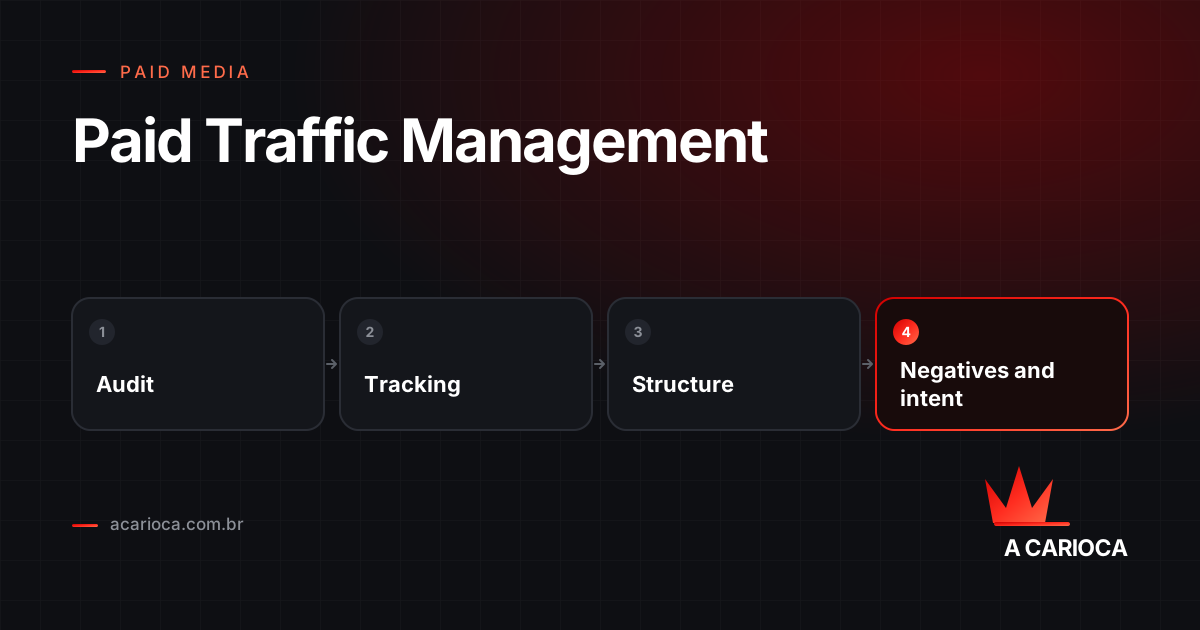
How we run an account.
- 01
Audit
What is already running, what it costs, and where the waste is. Before we touch anything.
- 02
Tracking
Conversions defined as real business events. If this is wrong, everything after it is fiction.
- 03
Structure
Campaigns organised so you can tell what is working without guessing.
- 04
Negatives and intent
Cutting searches that will never convert is usually the fastest saving available.
- 05
Iterate
Weekly adjustments, monthly reporting on cost per lead and revenue.
04 — Fit
Who paid traffic management is for.
It fits companies that already know what a customer is worth and need predictable volume: a clinic that needs a certain number of appointments a week, a B2B firm that needs qualified meetings, a store with margin to buy traffic. The common thread is a conversion that can be counted in money, not in visits.
It also fits accounts that are running but nobody trusts. Reports that look good while revenue stays flat usually mean the conversion is wrong, brand searches are being counted as wins, or budget is leaking on search terms nobody reviews. That is a management problem before it is a budget problem.
It is a poor fit for businesses whose site cannot convert yet, whose offer has not been tested, or whose margin does not cover the cost of a click in their market. We say so at the diagnosis stage, because the alternative is spending three months proving something a spreadsheet could have shown in an afternoon.
05 — Common mistakes
The mistakes we correct first.
- Conversions that are not conversions. A form view, a button click or a page visit counted as a lead teaches automated bidding to chase the cheapest non-event it can find.
- Brand and generic traffic mixed together. Brand searches convert cheaply and hide the real cost of everything else. We separate them so each campaign can be judged on its own numbers.
- No negative keyword routine. Broad match without weekly search term reviews sends a meaningful share of budget to jobs, tutorials and cities you do not serve.
- Landing pages that contradict the ad. The promise in the ad and the headline on the page have to match. Every step of reinterpretation costs conversions.
- Changes made too often. Automated strategies need a stable period to learn. Daily adjustments reset the learning and make results look random.
None of these require more budget. They are corrected inside the account, usually in the first two weeks, and the difference shows up in cost per lead before any new campaign launches.
06 — Measurement
How we measure and report.
The monthly report answers three questions: how much was spent, how many qualified leads or sales it produced, and what that cost per outcome was compared with the previous month. Impressions and clicks appear as context, never as the headline. When the business closes deals offline, we bring the CRM outcome back into the account as an offline conversion so the number we report is the one you recognise from your own records.
We also report what we changed and why: negatives added, bids adjusted, creative rotated, budgets moved. A report that shows results without decisions is not useful to anyone who has to decide whether to keep investing.
07 — Questions
Related services
Next step
Is your ad budget working?
Send us access or a screenshot of your account. We will tell you where the money is leaking before you commit to anything.
- WhatsApp · +55 24 99929-8231
- Email · [email protected]
- Volta Redonda, Brazil · remote worldwide